- Details
- By Chez Oxendine
- Energy | Environment
Wózu Inc. relied on generators to power its buffalo barn on the Standing Rock Reservation after the building’s electrical service was disconnected. Staff used the barn to treat animals and quarantine calves.
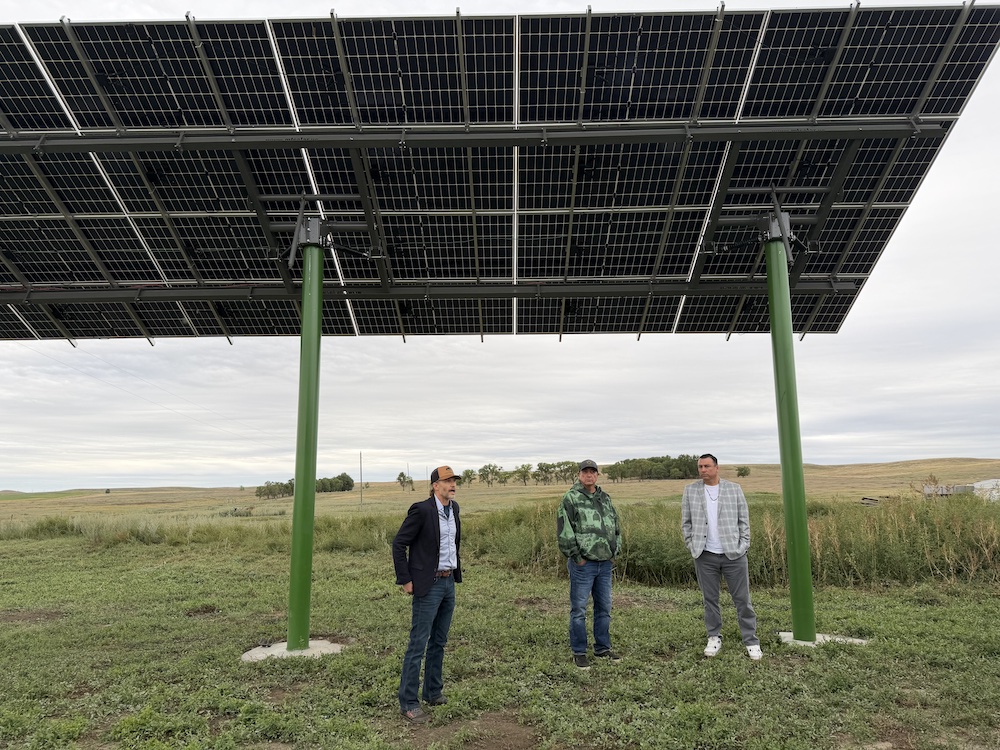
Indigenized Energy, a Native-led nonprofit focused on helping tribes develop renewable energy projects, offered a solution: a solar and battery system that would power the barn while providing shade for the herd. But building it meant accounting for the buffalo themselves, with elevated panels and reinforced supports to withstand an animal rubbing against the solar racks.
The roughly $200,000 project restored electrical service and added backup power for outages, said David Riley, Indigenized Energy’s chief strategy officer. The cost included barn improvements, air conditioning for the battery storage space and the array’s reinforced foundation. The nonprofit Tribal Energy Alternatives provided funding, and SolarEdge donated equipment, including the inverter and batteries.
The installation includes a 10‑kilowatt AC solar array — the largest system allowed by the local utility, Riley said. The barn now has stable power and backup capacity, he said. If the grid goes down, the herd facility stays lit.
The installation supports Wózu’s work in regenerative agriculture and buffalo restoration. It also places them at a growing intersection in Indian Country: agrivoltaics, or the use of solar structures that generate energy while supporting agricultural activity beneath and around them. A report from Fortune Business Insights estimated the global agrivoltaics market at $15 billion in 2025, with growth projected to reach $182 billion by 2034 as adoption increases.
Agrivoltaics are still relatively new in tribal communities, but interest is rising as climate pressures increase and farming becomes harder to sustain, according to Jen Rouda, founder of Portland, Ore.-based energy consultancy 7Skyline LLC. Agrivoltaics can help stabilize food production and land management in places facing heat, drought, and shifting growing seasons, Rouda said.
“Agrivoltaics can add an additional revenue stream to help keep farming viable for generations in areas impacted by climate change and reduced water availability,” Rouda told Tribal Business News. “Panels can cool the soil, increase crop productivity, reduce water use, and provide shelter for farm animals in addition to producing power for local community use.”
Rouda said the model is flexible enough to meet community priorities rather than forcing a one‑size‑fits‑all approach.
“Agrivoltaics practices can be customized to meet specific tribal community needs and preferences,” Rouda said. “Solar arrays can be engineered to be compatible with cattle or buffalo husbandry, and pollinator habitat and apiaries can be added to support local bees.”
Lon Richards, a consultant with Delaware City-based solar engineering firm Solar Volt LLC, said agrivoltaics answered two questions at once for many farmers: how to lower costs and protect land at the same time.
“You’re seeing droughts across the country and that’s creating both heat and water stress, as well as revenue stress,” Richards said. “But a good solar array can reduce some of that heat stress, protect some of your animals while they’re out in the field and lower energy costs all at once. That’s a powerful combination for any producer.”
Richards said he expects improvements in battery storage to increase interest in agrivoltaics. Beyond energy storage, batteries can provide platforms for other types of sensors, which can provide producers with more granular, moment-to-moment data on their crops and animals.
At Wózu, agrivoltaics took on a distinctly Native form. The solar array was engineered to generate energy for the barn, provide shade for the buffalo, and withstand animals that weigh as much as a car.
“If a buffalo decided to scratch its shoulder on a basic solar array, that would destroy it. So there’s a lot of extra concrete and steel to keep that array up high off the ground,” Riley said.
Buffalo restoration is a priority across the Dakotas, and Standing Rock’s herd is part of a research partnership with North Dakota State University studying how buffalo reintroduction improves the land.
“The buffalo is like a family member,” Riley said. “If you build a solar array for the buffalo program, you’re like building something for everybody’s grandfather.”
In a statement, Wózu founder Dave Archambault II said the project strengthens the program’s long-term stability.
“Alternative energy strengthens our ability to care for our buffalo, protect valuable food resources, support educational programming, and continue restoring our relationship with the land,” Archambault said. “This project is about creating the foundation that allows this work to continue expanding for years to come.”
Indigenized Energy hopes to replicate the model, though funding remains the main barrier. Riley said the organization has a backlog of buffalo‑related solar concepts it would pursue with more support.
“There’s so much good energy around these buffalo programs, because it is something so powerful and important,” Riley said. “If you help them, you’re really helping the community.”