


- Details
- By Thomas Stratmann
- Opinion | Op-Ed
Guest Essay. In the summer of 2019, a fire started along Interstate 5 in southern Oregon, at a spot the highway signs mark as Milepost 97. It burned into the forest that the Cow Creek Band of Umpqua Tribe of Indians had regained only the year before, when Congress placed more than 17,000 acres of the tribe’s ancestral homeland in trust for it.1 The fire destroyed about 3,600 of those acres and damaged more than 45 million board feet of timber.
[This story first appeared on Rules & Results and is republished with permission.]
Burned timber does not keep. Within a month, insects had moved into the dead and dying trees. Once the insects are in, commercial mills stop buying the wood, and the longer fire-killed timber stands, the more dangerous it becomes to recover. The tribe’s board of directors declared an emergency to speed the work. Tim Vredenburg, the tribe’s director of forestry, described it to me as a race against time.
The tribe believed its existing self-governance compact already covered the work, and it notified the Bureau of Indian Affairs (BIA) that it would begin the recovery.2 The BIA issued a cease-and-desist order. The tribe could not touch the wood until the full administrative approval process had run its course. That took eight months. Throughout the fall of 2019 and into the spring of 2020, the insects kept working while the paperwork moved along.
By the time the BIA cleared the tribe to proceed, much of the wood was past the point where any commercial mill would buy it. Cow Creek Umpqua had a way to recover it anyway. It had already entered a demonstration project, a trial run that Congress authorized in a 2016 law, the Indian Trust Asset Reform Act, or ITARA. By December 2020, its own management plan had won federal approval, giving it new authority to manage its trust forest. Using that authority, the tribe did what the delay had all but forced: it sold the insect-damaged wood to its own operation and bought a portable sawmill to process the wood that commercial mills would no longer take.
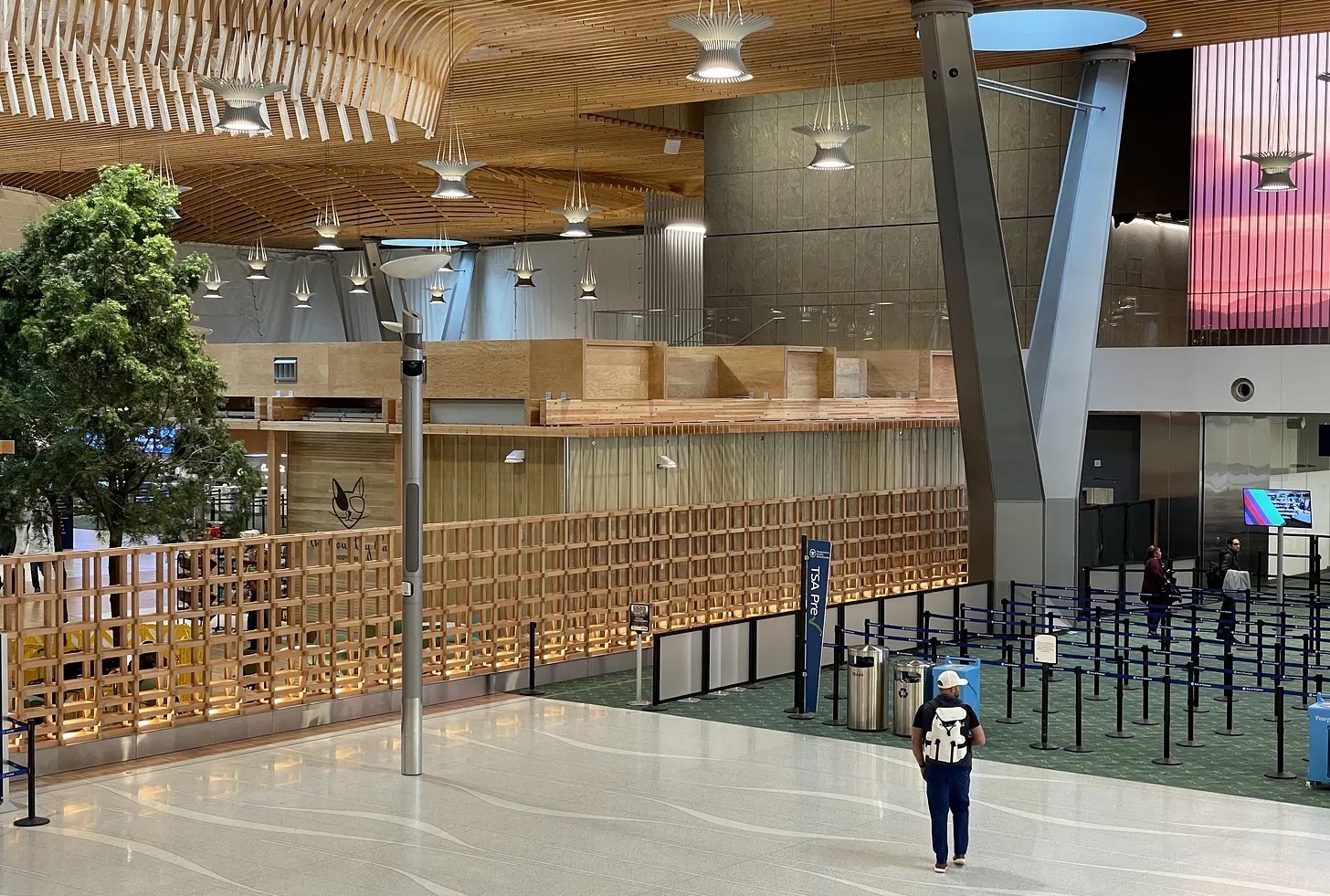
Some of that recovered wood now sits inside the Portland International Airport. In the terminal’s remodel, Cow Creek Umpqua timber became decorative lattice walls, ceilings over the retail spaces, and the linings of the privacy booths at the TSA screening area.3 A carved wooden sign on one of those lattice walls credits the tribe’s Douglas fir. That sale, Vredenburg believes, was probably the first timber sale anywhere in the country that a tribe approved on its own authority, with no federal sign-off.
The wood in the airport is the visible part of this story. What matters more is the eight months the tribe spent waiting for permission. As Vredenburg put it, even when the federal government is moving as fast as it can, it is still very slow.
I asked him where the delay had come from, back before the tribe held its own authority. Was it the BIA’s processing time, or was it the tribe’s own capacity, the staff and systems a tribe has to build to run a forest? His answer was one sentence. It was the BIA’s processing time. The agency, he said, is overworked and underfunded.
Under the older compact, the tribe could administer its forestry program, but, by his count, eighteen separate forest-management functions still required the BIA to sign off.4 In practice that meant preparing a project locally, a timber sale or a thinning plan, then sending it to the Bureau’s regional office in Portland, well to the north, for approval by staff who, in Vredenburg’s words, were not familiar with the land, the community, or the tribe’s values. That regional office carries about 48 tribes with a small staff. The bottleneck was never the tribe’s ability to manage its forest. It was the number of times someone else had to approve the managing.
There is a subtler point here, about how success itself was measured. Under the old process, Vredenburg said, what mattered was whether a program had followed the steps correctly, not what happened on the land. Under its own plan, the tribe judges success at home, by what actually happens on the land.
ITARA replaced those eighteen separate sign-offs with a single plan. A tribe writes it, gets it approved once, and then manages on its own authority.5
The difference showed quickly. George Smith, a retired BIA chief forester who has helped the tribes that entered the program, went back through the numbers for me: three months after the plan was approved, Cow Creek Umpqua had six timber sales in final preparation and had approved four of them on its own authority. Under the old process, by his estimate, those sales would have waited six months to a year for federal approval.
With that authority, the tribe has run prescribed burns and created fuel breaks, strips cleared of vegetation to stop wildfire from spreading. When another wildfire came through, those fuel breaks held, protecting not only tribal land but a nearby town. The tribe’s fuels-reduction work has guarded its neighbors and their infrastructure as much as its own ground.
The cost of getting there was real, but by Vredenburg’s account the tribe made it back fast. Whatever it spent building its plan and qualifying for the program, it recovered in the first year, he told me, in the first months, through the efficiency it gained. And this is not a story about less oversight. The work receives more environmental review than it did before, he said, not less. What changed is who does the reviewing, and how well they know the ground.
An earlier post here counted how few tribes have managed to get into this program at all. This one is about what the old approval process cost one tribe, and what changed once the tribe’s own plan took its place.
On June 22, 2026, the day the demonstration project would expire, the Interior Department extended it for ten more years, to 2036.6 That matters, because every management activity Cow Creek Umpqua has planned now runs on this authority, and a lapse would have halted that work heading into fire season.
But the extension is an administrative act, not a permanent one. A future Secretary could decline to renew it in 2036. The bill that would make the program permanent has had its hearing in the House but, as of this writing, awaits a committee vote and has no companion in the Senate.7
Smith also told me about a tribe that nearly ran out of time. It had worked through the entire process and was waiting for final approval as the June deadline arrived. More than a month later, it is still waiting: the issues have been resolved, and the plan now needs only the signature of the Assistant Secretary for Indian Affairs, a signature Smith says takes considerable time to secure. The people on both sides have been flexible and helpful, he told me, and he expects approval soon. The process is what takes the time.
Cow Creek Umpqua fought its fire twice. Once in the forest, and once in the eight months it spent waiting for permission to clean up after it. When the permission was finally the tribe’s own to give, the work moved at the speed the land demanded. The constraint was never the tribe.
Thomas Stratmann is a University Professor of Economics and Law at George Mason University and a senior research fellow at the Mercatus Center. He publishes Rules & Results on Substack and created the Reservation Economic Freedom Index.