- Details
- By Chez Oxendine
- Economic Development
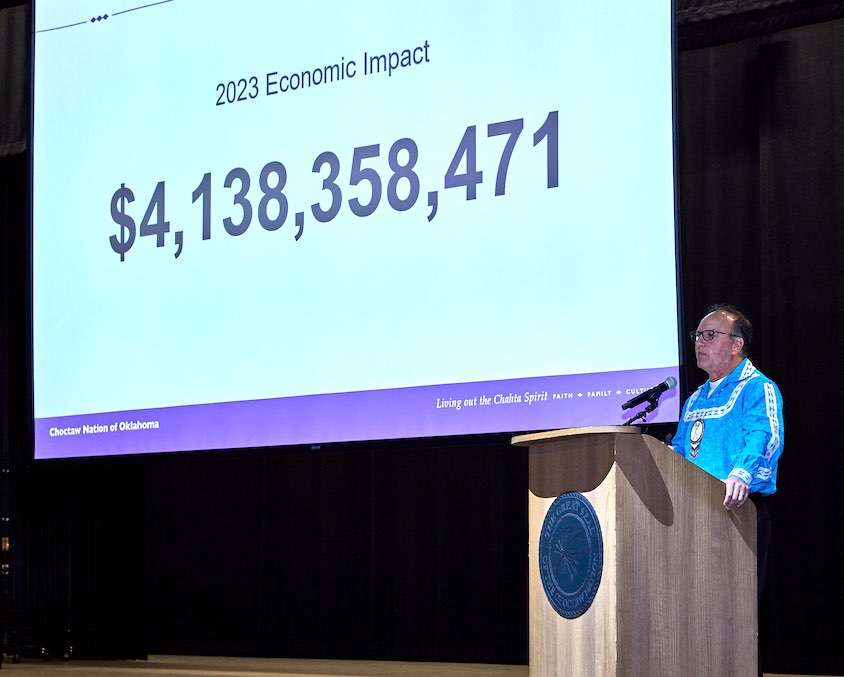
The Choctaw Nation of Oklahoma generated a $4.1 billion economic impact in 2023, supporting 26,917 jobs and $1.65 billion in wages and benefits, according to a new analysis.
The analysis, prepared by economist Kyle Dean, was presented during a press conference attended by tribal, state, county and local officials. The 2023 total represents a 28% increase from $3.2 billion in 2021.
Dean said the findings show the tribe’s economic activity extends well beyond its reservation boundaries.
“The Choctaw Nation’s $4.1 billion economic impact is not just a statistic. It represents jobs created, communities strengthened and opportunities expanded across Oklahoma,” he said in a statement released by the Choctaw Nation.
Chief Gary Batton said the growth reflects the tribe’s workforce and partnerships across the region.
“We have become a major driver in the economy of southeastern Oklahoma and the state of Oklahoma,” he said.
Education spending remained one of the tribe’s largest financial contributions to the state. Choctaw Nation paid $45.1 million in gaming exclusivity fees in 2023 and more than $422 million since the compact, with payments supporting public education across Oklahoma.
Separately, the tribe also invested $72 million in its own education programs, funded 12,368 college scholarships and supported 4,821 students in summer school across 52 districts.
Batton said the goal is to “grow the next generation,” pointing to youth programs that reached more than 2,000 participants last summer.
Housing and community development also expanded. The tribe built 153 new homes in 2023 and more than 1,300 since 2018.
The tribe also provided $3.6 million in rental assistance and installed 566 storm shelters, a program Batton said becomes “mission critical” during tornado season.
Through its community partnership funds, the tribe contributed $3.6 million to local governments and invested $5.2 million in transportation projects.
Health care spending reached $293 million last year, with more than 1.1 million outpatient visits and 1.6 million prescriptions provided.
Batton highlighted the tribe’s role in reducing state Medicaid costs, noting that care for tribal citizens is funded entirely by the federal government. “That saves the people of Oklahoma, the taxpayers, dollars,” he said.
Batton closed by underscoring the Nation’s long-term commitment to the region.
“The Choctaw Nation is not moving anywhere,” he said. “We’re going to keep all of our dollars right here in southeastern Oklahoma to grow our economy.”