- Details
- By Tribal Business News Staff
- Energy | Environment
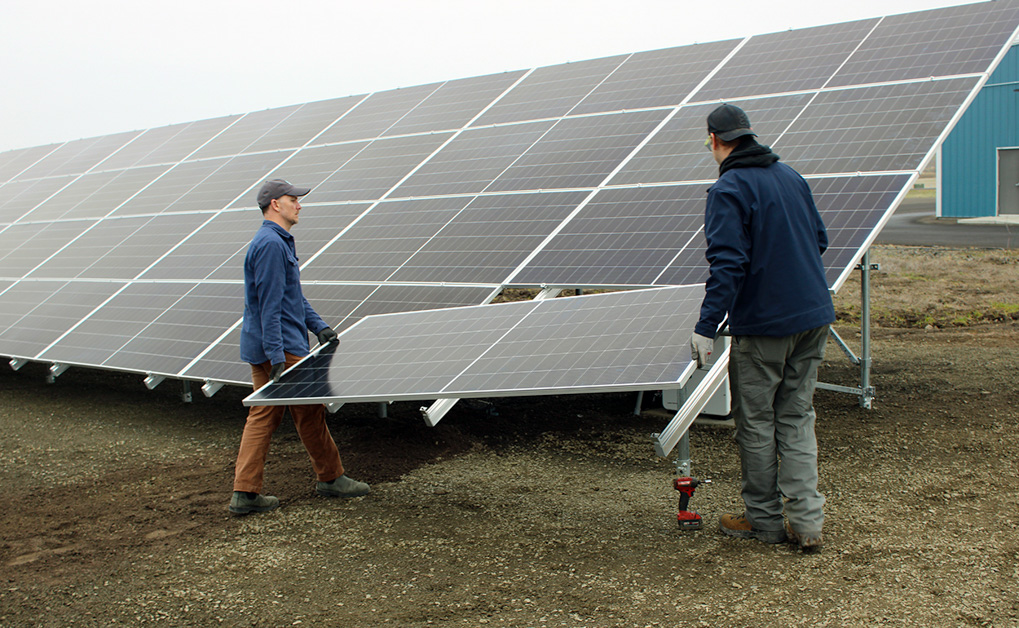
The Confederated Tribes of the Umatilla Indian Reservation completed a $370,000 solar installation at the tribe’s Tutuilla Food Sovereignty Center on Feb. 4, adding on-site renewable energy capacity and battery storage at a high-demand food distribution facility.
The system includes 200 photovoltaic panels and 176 megawatt-hours of battery storage and is expected to generate about 176,125 kilowatt-hours annually, according to Patrick Mills, a CTUIR climate coordination specialist.
The four photovoltaic arrays were built behind the 10,500-square-foot building, which houses refrigeration and freezer units for the Food Distribution Program on Indian Reservations.
“The building uses a relatively large amount of electricity due to the refrigeration and freezer units for food storage inside,” Mills told the tribe’s Confederated Umatilla Journal. “We estimate the solar PV array system will save the CTUIR more than $16,000 per year on electricity bills.”
Electricity costs for the center ranged from $10,482 to $17,880 between 2022 and 2024. Mills said rising utility rates could increase the value of the system’s savings over time.
Officials from the tribe’s Department of Economic and Community Development told East Oregonian the building uses upward of 149,000 kWh per year based on electricity bills from July 2021 to February 2025. Mills said the system was intentionally oversized by about 18% to account for panel degradation and potential increases in demand.
The project follows a 2022 Board of Trustees resolution directing deployment of non‑greenhouse‑gas‑emitting power generation technologies as part of the CTUIR Strategic Energy Plan. The Department of Economic and Community Development managed the project, with Power Northwest serving as the prime engineering, procurement and construction contractor. Bryson Picard Grading & Excavating, a tribal member‑owned business, completed pre‑construction site work.
Construction took about 10 days after site preparation. Mills said the system is expected to be energized this month pending installation of a smart meter and a final inspection by Pacific Power.
The project was funded through the Washington Climate Commitment Act. An Energy Trust of Oregon incentive will reduce the final cost to about $320,000.