- Details
- By Chez Oxendine
- Economic Development
The Cherokee Nation has launched a new initiative to drive job creation and private investment in distressed areas of its reservation by deploying its State Small Business Credit Initiative (SSBCI) allocation through a targeted lending program.
The now‑approved program designates more than 180 U.S. Census Bureau tracts as Cherokee Opportunity Zones, using criteria such as poverty levels, concentration of Cherokee citizens, fluent Cherokee speakers and existing tribal infrastructure. Each tract meets a minimum poverty threshold of 19%, according to the tribe.
Entrepreneurs starting or expanding businesses in these zones gain access to direct microloans of $25,000 or less, or larger loans up to $5 million from the Cherokee Nation Economic Development Trust Authority, a community development financial institution (CDFI). The authority will deploy capital from the Cherokee Nation’s $84 million SSBCI allocation, positioning the program as a credit-enhancement and gap-financing tool rather than a grant program.
The program offers incentives and financial advantages over standard Cherokee Nation business loans. Opportunity Zone microloans carry interest rates 2% below the tribe's base rate and require no equity contribution, providing 100% project financing — a structure designed to reduce upfront capital barriers in high poverty markets.
Borrowers can receive up to seven years for microloans and 15 years for larger loans, with the option to defer payments for six months with interest-only payments. Those terms mirror long-horizon community development lending rather than conventional small-business credit.
Unlike standard Cherokee Nation business loans limited to federally recognized tribal citizens, Opportunity Zone financing is available to any U.S. citizen residing or operating a business in the designated areas.
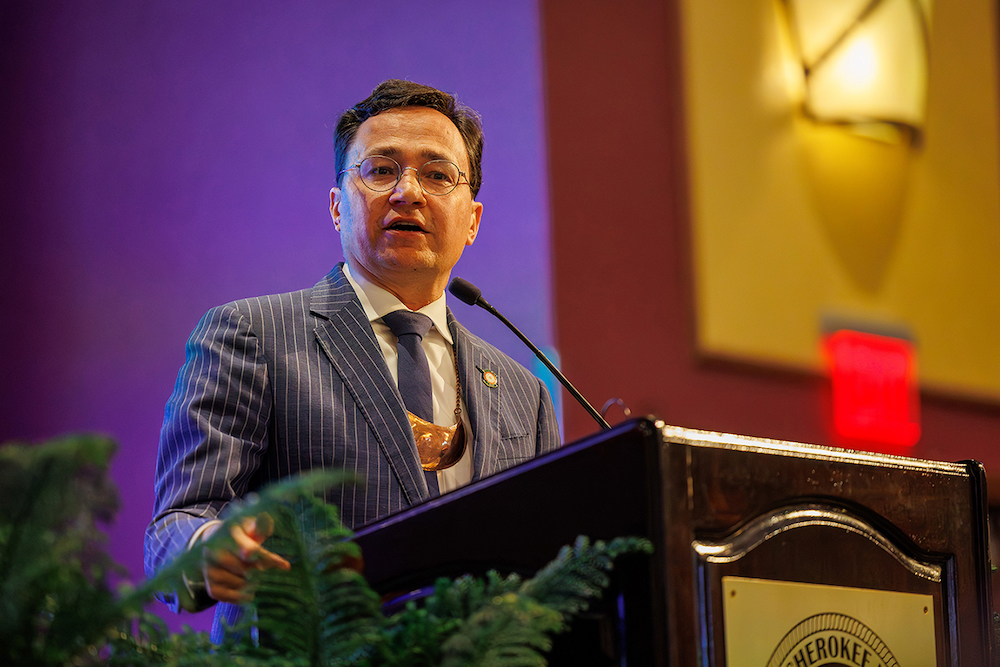
Principal Chief Chuck Hoskin Jr. told Tribal Business News the initiative would help “raise the floor” in some of the Cherokee Nation’s most vulnerable communities.
“We have a strong bottom line by many measures, but I suggest those measures are incomplete,” Hoskin said. “We need a new bottom line based on equity so that no community is left behind.”
The tribe also plans to direct more of its on-the-job training funds to small businesses investing in these areas, as well as provide wider economic development training and business coaching in each community, pairing lending with technical assistance — a core SSBCI objective.
Deputy Chief Bryan Warner said the initiative is designed to reach communities that feel overlooked.
“We know that there are still some communities in the Cherokee Nation where poverty is high, hope is low and there is a feeling among community members that the rest of the world forgot about them,” Warner said. “This plan is one more way we can demonstrate that the Cherokee Nation did not forget about them and that we want to help these communities succeed.”
The Cherokee Nation’s plan echoes but diverges from the federal Opportunity Zone framework created in 2017. Nationally, about 30% of reservation lands are designated as federal opportunity zones, per a 2023 report by consulting company Easy OZ. These zones allow investors to defer capital gains taxes by reinvesting in businesses or property located in economically distressed communities.
By tailoring opportunity zone programs to their own communities, tribes can exercise greater control over capital placement, underwriting priorities and cultural considerations, Hoskin said. Cherokee Nation’s inclusion of fluent Cherokee speakers as a factor in zone designation reflects this approach, linking economic investment to cultural preservation.
The Cherokee Opportunity Zone plan builds on the tribe’s existing economic development programs, which include support for tribally owned businesses and partnerships with federal agencies. By combining micro loans, matched federal funds and workforce training, the initiative aims to create a comprehensive support system for entrepreneurs in disadvantaged areas.
Hoskin said the program is part of a broader vision to ensure equity across the reservation.
“We need to measure success not just by financial strength but by whether every community has the opportunity to thrive,” he said.
Brian Edwards contributed reporting.