- Details
- By Brian Edwards
- Finance
The number of Native community development financial institutions has remained largely unchanged for more than a decade — even as demand for capital in Native communities continues to grow. That may be starting to change.
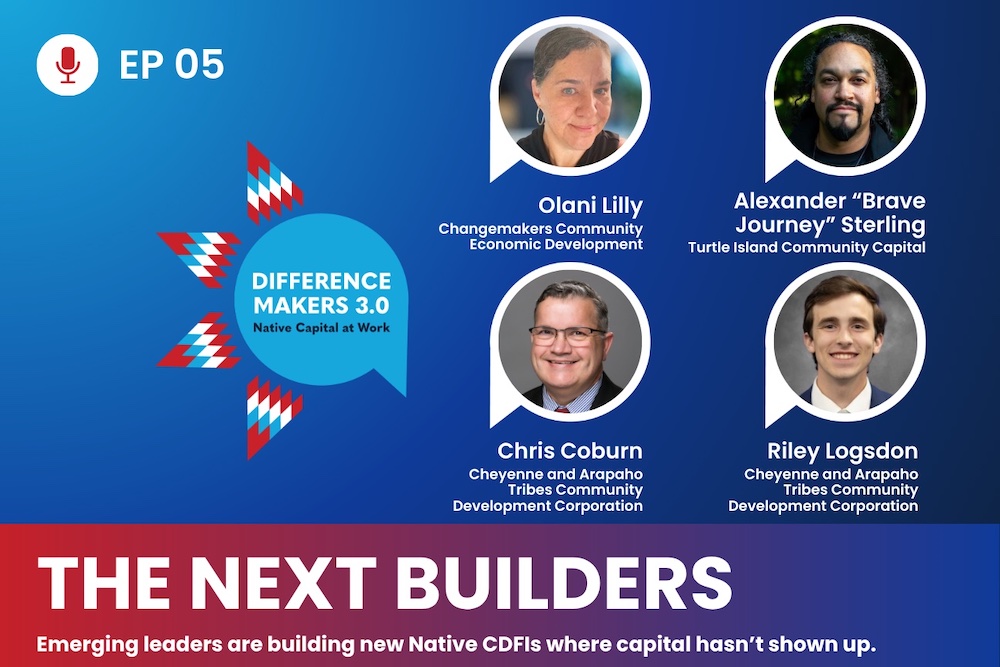
In Episode 5 of Difference Makers 3.0, host Brian Edwards speaks with leaders building new Native CDFIs in Oklahoma, Hawai‘i and the Northeast — part of a growing wave of emerging institutions working to expand access to capital in communities that still don’t have it.
Today, there are about 65 certified Native CDFIs nationwide. But nearly three dozen emerging Native CDFIs are underway, as communities work toward certification and build the infrastructure needed to lend.
The episode features Kristen Wagner of the Native CDFI Network, along with leaders from the Cheyenne and Arapaho Tribes Community Development Corporation in Oklahoma, Changemakers Community Economic Development in Hawai‘i, and Turtle Island Community Capital in Rhode Island.
Together, their stories show how the next generation of Native CDFIs is taking shape — not through a single model, but through approaches grounded in the needs of individual communities.
In Oklahoma, the Cheyenne and Arapaho Tribes Community Development Corporation is building a tribally affiliated lending institution, starting with small business loans and expanding toward consumer lending in communities where predatory lending is common.
In Hawai‘i, Changemakers Community Economic Development is building a model rooted in relationships and community values — where lending is one tool among many to support long-term economic resilience.
And in the Northeast, Turtle Island Community Capital is working to build a Native CDFI in a region that has historically lacked access to Native-led financial institutions, identifying what one leader described as at least $180 million in unmet demand.
Here are highlights from the episode:
On the growth of the movement:
“We’ve discovered over 30 communities that are in the process of developing a Native CDFI from all ranges of phases. We wanted to make sure that NCN was a key supporter for those Native CDFIs. This is a network that is continuing to grow.”
On what it takes to build one:
“It takes a lot of time and persistence and support to start a Native CDFI. These folks have to start everything from gaining 501(c)(3) status, to developing their governance structure, to building a lending portfolio. And then they have to secure capitalization so they actually have capital to provide to the community.”
On meeting borrowers where they are:
“We want to help you be successful in your business — it doesn’t matter what stage you are at. We’re a lot more open to some of those lower credit or riskier loans than a lot of other lenders. That’s where we can really step in for some of these rural communities.”
On the need for alternatives to predatory lending:
“Mainly because the capital is tight, especially in a rural environment, what’s plentiful is predatory lending. So giving people an option with a fair interest rate is critical. You want to help people grow their capacity to where they’re not desperate — they have choices.”
On rethinking finance:
“We see CDFI as a tool — a means to an end. What we are really doing is using that tool to bring resources into our Native communities and support businesses and food infrastructure. It just made sense as something we could add to our toolbox.”
On the scale of unmet demand:
“We identified something like $180 million worth of investable opportunities. And I know that is a tiny fraction of what is actually out there. Most of the businesses we encounter have never heard of a CDFI and have already exhausted every other option.”
On what drives the work:
“Because I have three kids, and I know the challenges I had to face to get where I am. I don’t want them to have to fight that hard. If I have to put in the work now to help build an economy that recognizes their potential, I’ll do it all day long.”
Visit Difference Makers 3.0 to listen to the full episode and subscribe on your favorite podcast platform.