- Details
- By Chez Oxendine
- Policy and Law
The Senate Committee on Indian Affairs approved legislation Wednesday that would give all federally recognized tribes authority to issue 99-year leases on trust lands, a change tribal leaders say is critical for attracting investment and financing development projects.
The committee advanced S. 3383, the Unlocking Native Lands and Opportunities for Commerce and Key Economic Developments Act of 2025, or UNLOCKED Act, which would amend the Long-Term Leasing Act of 1955. An earlier version of the bill, S. 1322, passed committee but was held at the House desk in November 2024.
Sen. Lisa Murkowski, R-Alaska, who co-sponsored the measure with Sen. Brian Schatz, D-Hawaii, said the bill would allow tribes to self-regulate their land leases and right-of-way procedures.
"Sen. Schatz and I introduced this bill to give all tribes 99-year-leasing for their trust lands," Murkowski said. "In today's economy, a 50-year lease is just not long enough to secure financing for infrastructure and economic development projects. It also doesn't make sense for Congress to keep passing individual, separate standalone bills for tribes."
The committee also heard testimony on four tribal-specific bills addressing lease authority, jurisdictional barriers and land transfers.
Mashpee seeks longer leases
The Mashpee Wampanoag Tribe is seeking authority under S. 236 to issue 99-year leases, up from a current 25-year cap under the Long-Term Leasing Act. Chairman Brian Weeden told senators the restriction limits the tribe's ability to attract capital for long-term planning.
"Having been landless for so many generations, Mashpee now desperately needs economic development to build an economy to support our people," Weeden said.
The Department of the Interior supported the bill, stating tribal governments are best positioned to determine appropriate lease terms.
Shivwits addresses court ruling
The Shivwits Band of Paiutes testified that S. 1508 would resolve a jurisdictional problem created by a 2022 federal court ruling that found Utah courts cannot hear certain civil cases involving tribes unless Congress explicitly authorizes it — even when tribes waive immunity and consent to state court jurisdiction in contracts.
Chairwoman Tina Gonzales said the decision has discouraged businesses from working with the tribe because of uncertainty over dispute resolution.
"Without assurances that there will be a forum available in which to resolve disputes, the Shivwits Band is concerned that this opportunity, and any future opportunities, will not be realized," she said.
The bill would allow the tribe to consent to Utah state court jurisdiction on a contract-by-contract basis without requiring a broad waiver under Public Law 280.
Land-into-trust bills
Two bills would transfer federal land into trust for tribes facing housing shortages and seeking cultural restoration.
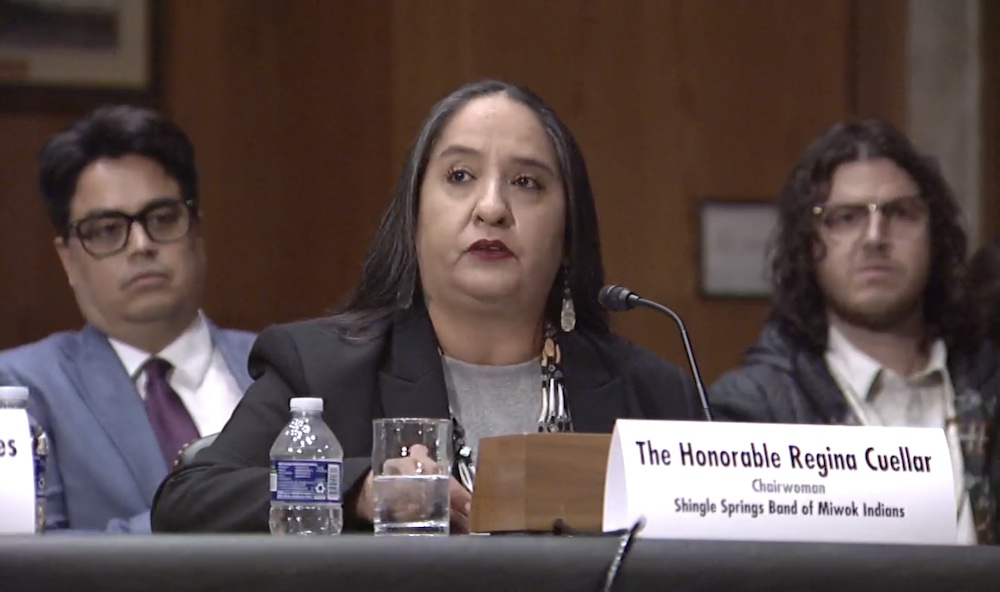
S. 2735 would place roughly 204 acres into trust for the Shingle Springs Band of Miwok Indians, including the Indian Creek Ranch property that has county-approved residential development plans. Chairwoman Regina Cuellar said the tribe has 198 families on its housing wait list.
"This legislation is vital to our tribe's future," Cuellar said. "It advances tribal self-determination, addresses an urgent housing crisis and helps correct historic land-use decisions that continue to affect our community today."
S. 1513 would transfer more than 1,000 acres of former hydroelectric project lands into trust for the Lower Elwha Klallam Tribe. Chairwoman Frances Charles said the land is central to the tribe's cultural identity and restoration of the Elwha River ecosystem after dam removal.
"We look forward to the day when, after more than 100 years, restored runs of our salmon relatives once again fill the Elwha River with life," she said.