


- Details
- By Brian Edwards and Chez Oxendine
- Economic Development
These were our favorite stories of 2025 because they reflect Indian Country as it actually is — and the kind of journalism we’re committed to doing. Not aspirational. Not abstract. Just stories grounded in decisions tribes and Native people are making right now about land, labor, capital and culture.
In these stories, sovereignty shows up in the specifics. It’s a landback deal negotiated without conservation easements. It’s tribes training their own energy workforce when federal support falls short. It’s Native lenders pooling capital on deals they’ve been excluded from in the past. It’s entrepreneurs refusing to strip culture out of their business models just to sound “fundable.” These stories show how Indigenous business works in practice, often outside the systems that were never designed to accommodate it.
They also reflect our editorial priorities: follow the money, question the assumptions and tell the truth when Native nations are misrepresented or used as cover — whether in fraudulent “tribal tax credit” schemes or broad political attacks on Native contracting enterprises. Together, these stories capture a year that was messy, consequential and instructive.
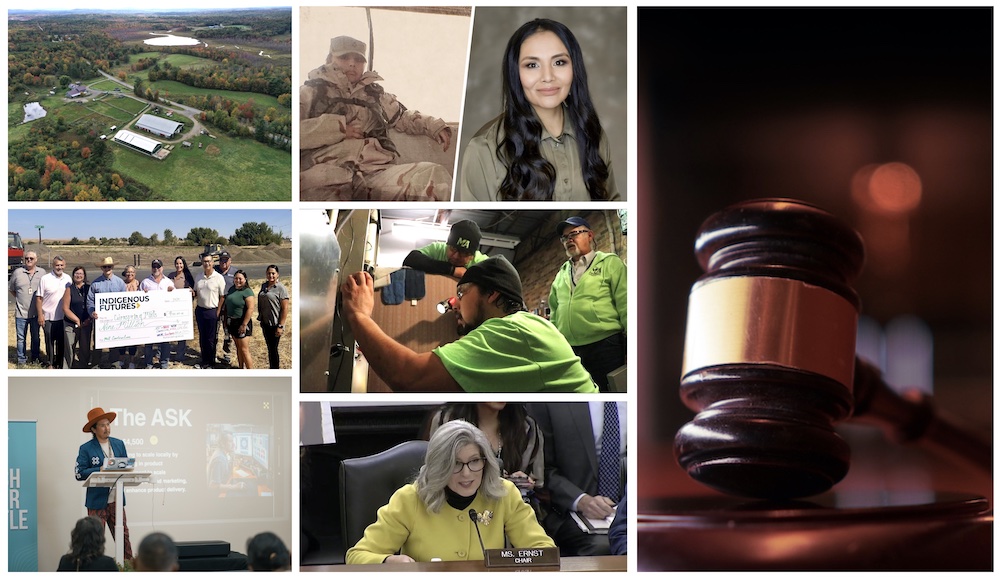
Wabanaki collective secures 245 acres without conservation easements in rare landback deal
Niweskok, a nonprofit representing Maine's Wabanaki Confederation tribes, secured 245 acres of farm and forest in January—but what made this landback story remarkable was what they didn't accept: conservation easements. While many landback projects rely on easements to attract foundation support, these restrictions p up can limit sovereign control over returned lands. Niweskok's co-director Alivia Moore told me they “fought and pushed” to avoid easements entirely. “This isn't the sort of conservation project people are used to funding,” Moore told me, “but it's actually been really incredible to hear folks say ‘I'm so glad you're going to be able to enact Wabanaki values freely.’” True sovereignty means making your own land management decisions. Chez Oxendine
California tribes launch renewable energy workforce program to build homegrown expertise
One refrain we heard repeatedly in energy reporting this year: tribes want to do it themselves. In August, California's Karuk, Yurok, Hoopa Valley and Blue Lake Rancheria tribes pooled resources to launch a four-week crash course in renewable energy construction, designed by Iowa's Meskwaki Nation. “It's a paycheck paired with education,” Meskwaki apprenticeship director Matt Bear told us. “By training our own, we're planting seeds to cultivate local talent... showing it's possible to run an apprenticeship, graduate folks, and bring those skill sets back into the community.” The collaborative approach also demonstrated how tribes are pooling resources to fill yawning gaps in federal funding post-Trump—gaps that elsewhere have stalled similar workforce development programs before they could launch. Chez Oxendine
Indigenous pitch competitions close the capital gap — and the culture gap
Indigenous-led pitch competitions are reshaping how Native entrepreneurs access capital—and it's not just about the money. Participants get mentorship, training, and experience articulating their business models, with prizes ranging from $1,000 to $25,000. But what makes these competitions transformative is their culturally-driven criteria. At Michigan's 20Fathoms tech incubator, their IndigiPitch competition judged community impact alongside profitability. “[Indigenous entrepreneurs] tend to look at things differently—it's not just about building wealth, but considering what kind of impact you're making, considering Mother Earth, thinking about those next seven generations,” CFO Shiloh Slomsky told us. Pow Wow Pitch participant Christine Falcon said competing “in a space that is centered like this gave us more of an opportunity to go for funding in such an authentic way.” Chez Oxendine
Native CDFIs partner in $9M financing for flour mill on Umatilla Reservation
I traveled to Oregon to witness something remarkable: eight Native CDFIs pooling capital in a $9 million loan for a regenerative flour mill on the Umatilla Reservation. While Native lenders have long done participation loans, this “capital weave” took collaboration to a new level—smaller institutions joining forces to tackle deals previously beyond their reach. In a year that saw accelerated attacks on the CDFI Fund, this story showcased the power and sophistication of Native-led finance. It's not just about one mill; it's a blueprint for how Indigenous lenders can build capacity and transform tribal economies together. Brian Edwards
Freelance writer Tamara Ikenberg delivered one of the year's most powerful profiles: a Purple Heart recipient who transformed combat trauma into entrepreneurial purpose. A mortar attack in Baghdad ended Rose McFadden's military career, leaving her with permanent injuries. She found healing through art, eventually building Isabella Rose Design Co. while lifting up her community. My favorite line in the story — and maybe of the year —captures everything about why she named the company after her daughter: “I want her to get up when she falls and go after it again and again and again—that's my business model.” In a year dominated by policy threats, this story reminded us why supporting Indigenous entrepreneurs matters: their resilience and vision build pathways for future generations. Brian Edwards
Florida couple sues to recover $1.6M paid for 'tribal tax credits' the IRS says don't exist
This story defies logic: high-income investors paid tens of millions for "tribal tax credits" that were never authorized by the Treasury Department and don't actually exist. We'd been hearing whispers throughout 2024 but didn't have resources to investigate—thankfully, Bloomberg and Sens. Wyden and Cortez Masto did. A Florida couple's lawsuit to recover $1.6 million exposed a "sprawling scheme" that misused tribal identities, involved Trump's IRS nominee Billy Long, and fooled accountants at major firms. The Cherokee Nation sent cease-and-desist letters. The case spotlighted how tribal sovereignty can be exploited by bad actors preying on investors' ignorance, leading to continued congressional scrutiny and legislation. Brian Edwards
Native firms challenge Ernst's effort to halt SBA's $25B 8(a) program
Everyone in federal contracting acknowledges some bad actors exist and there needs to be constant oversight and clean-up of programs like the SBA's 8(a). But Sen. Joni Ernst's December call to pause the entire program—which generated $16.1 billion for Native enterprises in 2024—was a clear overreach. The Iowa Republican cited several tribal and Alaska Native companies in letters to 22 federal agencies, but those firms told us Ernst's allegations relied on flawed data and misinterpretations of SBA rules. More troubling: none were contacted before being publicly accused. Cherokee Federal, Hawaiian Native Corporation, Calista, and Poarch Creek all disputed her claims. Even Republican Sen. Lisa Murkowski called Ernst's proposal misguided. Ernst has every right to demand accountability and accuracy from Native contractors, but lawmakers owe companies the same standard. Brian Edwards