- Details
- By Chez Oxendine
- Real Estate
The Pascua Yaqui Tribe invested about $1.5 million of its own money to develop a $27.3 million housing complex for tribal elders by leveraging Low-Income Housing Tax Credits, a financing model tribal leaders say has become central to expanding housing while limiting the tribe's capital investment.
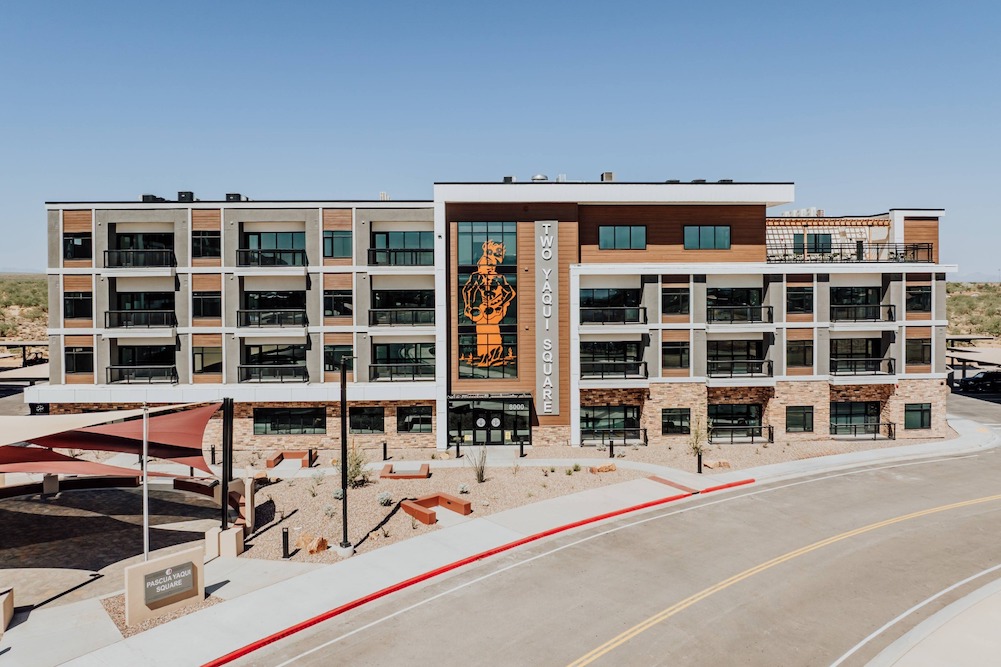
The 45-unit development, known as Two Yaqui Square, opened this spring after the tribe partnered with Native-focused community developer Travois to secure the tax credit financing. The project is the tribe's 10th financed through the Low-Income Housing Tax Credit program and the fourth phase of the broader Yaqui Square development, which has produced 172 affordable housing units for tribal members.
“That’s 45 homes for $1.5 million, where else can you do that?” Pascua Yaqui Housing Director Ricardo Vital said.
The four-story building was designed to support aging in place with oversized balconies, large windows, low-step showers, in-unit washers and dryers, emergency pull cords and space for visiting health care providers. Rent and utilities are capped at $100 a month, with the tribe subsidizing the remaining costs to keep the apartments affordable for elders on fixed incomes.
Construction began shortly after the tribe closed financing at the end of 2023. Work finished earlier this year, and elders began moving in this spring. The grand opening was held in April.
“This is a tremendous blessing to our community for our elders to live in the same place,” said Rosanna Dominquez, senior center director for the Pascua Yaqui tribe, in a statement provided to Tribal Business News. “Because it allows the teachings to continue to other generations. It allows our cultural traditions to remain strong. The biggest thing that the elders love is that it’s in the reservation.”
The development represents the tribe’s 10th LIHTC project and reflects a decade of work to expand housing options for tribal members. The total development cost reached about $27.3 million.
According to Travois senior project manager Meaghan Hosterman, the project brought in $21.6 million in LIHTC equity and secured $1 million each from the Federal Home Loan Bank of Des Moines and the Federal Home Loan Bank of San Francisco through the Affordable Housing Program. The tribe contributed $3.7 million, but the developer fee returned through the LIHTC structure will reduce the net tribal contribution to about $1.5 million.
Hosterman said the LIHTC allows tribes to complement housing funds under the Native American Housing Assistance and Self-Determination Act (NAHASDA).
“It creates an opportunity where a tribe can come in with a larger master plan and plan out what they need, talk to their community about what they need, and access a large amount of funding that aligns closely with what they're already doing,” Hosterman said. “The amount of equity that can be brought in through that partnership—the private-public partnership developed through the Low-Income Housing Tax Credit program—really brings in a lot of that gap funding.
“It creates economies of scale where you can build a large amount of homes and units.”
Vital said the tribe’s investment reflects a long‑term commitment to addressing a housing waitlist that includes about 1,200 members. He said LIHTC has become central to the tribe’s ability to build homes at a scale not possible through other funding sources. The program’s structure allows the tribe to leverage private equity, reduce its direct capital burden and plan multi‑phase developments that align with community needs.
Around 60% of the 700-plus homes the tribe has built for tribal members were financed through LIHTC, Vital said.
“The impact that safe housing has on our health is huge, but it’s been really hard to actually build on the reservation, for many reasons,” said Herminia Frias, co‑chair for housing oversight. “We are doing our best to expand and have homes for families. Low‑Income Housing Tax Credit has really helped us get things going.”
Vital said the tribe is preparing its next LIHTC application as part of a five‑year plan to expand housing across its communities in Arizona. He said the goal is to continue building at a pace that meaningfully reduces the waitlist and supports elders, families and future homeowners.
“We’re still trying to figure out if we want to do single‑family homes or multi‑generational homes. But the proposed one that we have right now is 34 or more homes that will eventually turn into homeowners,” he said. “If everything works out, that’s 34 homes for a tribal investment of $1.4 million. Again, you have to ask, where else can you do that?”