


- Details
- By Native StoryLab
- Sponsored Storytelling
As artificial intelligence (AI) and precision medicine transform healthcare and scientific research, Indigenous leaders say tribal nations must prepare to govern one of their most valuable resources: their data.
For generations, tribal governments have fought to reclaim authority over land, water, minerals and other natural resources. Today, Indigenous leaders say another strategic asset is emerging — one that can’t be fenced, mined or drilled, but may prove just as important to the future of tribal sovereignty: data.
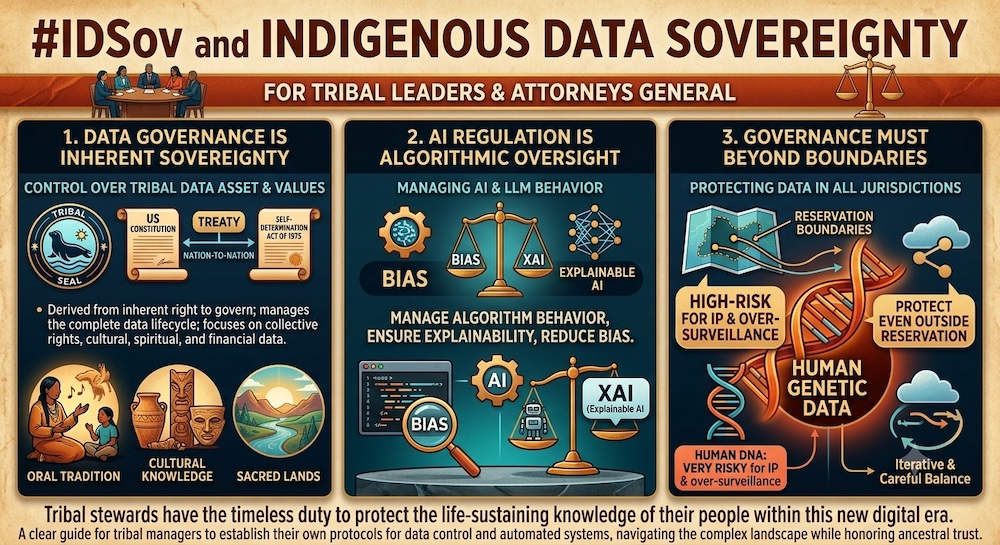
Artificial intelligence and precision medicine are rapidly increasing the value of genomic and health information. As governments, universities and private companies invest billions in these technologies, a growing movement across Indigenous communities is asking a crucial question: Who should decide how data from Native peoples is collected, governed and used?
For Joseph Yracheta, founder of the Native BioData Consortium on the Cheyenne River Sioux Reservation, the answer has never been about genetics alone.
“It really isn't about DNA,” he said. “It's about sovereignty.”
For Yracheta, the concern isn’t limited to how researchers collect and store genomic information. It’s whether tribal nations have the governments, laws, technical expertise and Indigenous-led institutions needed to set the terms for research and emerging commercial partnerships.
That includes determining what data may be collected, who may access it, how it may be used and whether Native communities share in the health, scientific and economic benefits it helps create.
The Rules are Being Written
Tribal and First Nations leaders have spent years pressing public agencies, research institutions and policymakers to recognize Indigenous authority over data connected to their citizens, communities, lands and resources. Today, their focus has shifted from broad principles to the governance frameworks and institutions needed to shape major research initiatives.
In the United States, the National Congress of American Indians has adopted a series of resolutions affirming Indigenous data sovereignty and calling for tribal oversight of research and emerging technologies. In Canada, the Assembly of First Nations recently opposed the inclusion of First Nations genomic data in the Canadian Precision Health Initiative without meaningful consultation, consent and First Nations-led governance.
Together, those actions reflect a broader shift. Indigenous governments increasingly view data governance not simply as a question of research ethics or privacy, but as an issue that will influence public health, economic development, intellectual property, workforce development and future partnerships with universities, governments and industry.
According to Yracheta, those discussions are becoming more urgent as AI accelerates scientific discovery and governments and private industry invest billions in biotechnology, critical minerals, digital infrastructure and other data-driven industries.
AI is compressing the timeline for decisions about research, commercialization and resource development, making it more important than ever for tribal nations to build their governance capacity, he said.
“These are governance issues,” Yracheta said. “They're economic development issues. They're sovereignty issues.”
Building Capacity for the Future
For Yracheta, the answer begins with institutions. NativeBio was created to help tribes build the scientific, legal and governance capacity needed to make informed decisions about research and emerging technologies.
Rather than asking tribes simply to participate in research, the organization works with tribal governments, researchers and educational institutions to strengthen research capacity, expand the Native scientific workforce and develop Indigenous-led approaches to data governance.
Yracheta points to Indigenous organizations in Australia and New Zealand as examples of communities that began investing in Indigenous-led governance and research institutions years earlier. Although their legal relationships with national governments differ from those of federally recognized tribes in the United States and First Nations in Canada, he said their experience demonstrates the value of building institutions before major policy and commercial decisions are made.
For Yracheta, the goal is not to slow scientific progress. It is to ensure tribal nations have the institutions, expertise and governance capacity to help shape — and benefit from — the next generation of research, innovation and economic development.
“We're building institutions,” Yracheta said. “We're building institutions. We're helping tribes ensure their lifeways and keep many information pathways tied to their identities & land inheritances. We want tribes to prepare for a future where data will play an increasingly important role in that via healthcare, research and economic development.”
Just as tribal nations have built institutions to govern land, finance and economic development, Yracheta believes the next generation of nation-building will require institutions capable of governing data and the opportunities it creates.
ABOUT: As global demand for data grows, Indigenous peoples remain underrepresented in the economic and sovereign benefits generated from their data. The Americas’ unique population history has produced important discoveries in genomic and omic sciences, yet Indigenous communities retain limited control over how those discoveries are used and commercialized. Native BioData Consortium aims to change that imbalance through Indigenous Data Sovereignty frameworks that give communities greater authority over their data. Its model offers a new standard for ethical, legal and self-determined data stewardship as artificial intelligence rapidly expands the value and uses of biological data.