- Details
- By Chez Oxendine
- Policy and Law
The Senate Committee on Indian Affairs heard from federal officials, researchers and tribal leaders Wednesday about the scale of the housing crisis facing Native communities and proposed changes to the primary federal law supporting tribal housing.
Witnesses described overcrowded homes, rising construction costs, aging infrastructure and federal programs that have not kept pace with need. The hearing focused on the Native American Housing Assistance and Self-Determination Modernization Act of 2026, or NAHASDA Modernization Act, a proposal to update the 30‑year‑old law and expand tribal access to financing, streamline federal requirements and strengthen support for Native veterans.
“For three decades, this landmark law has been built around a simple principle for tribal housing: that tribes, not Washington, are best positioned to determine the housing needs of their communities,” Sen. Lisa Murkowski, R-Alaska, said in her opening statement. “This anniversary gives us an opportunity not only to reauthorize the law but to ensure it's ready to meet the housing challenges of the next 30 years.”
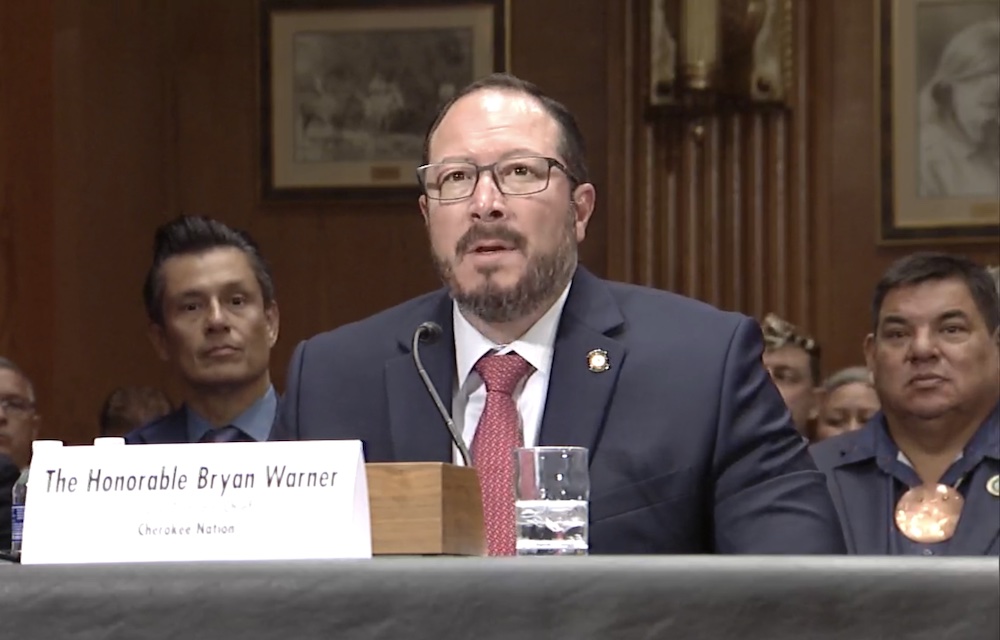
Cherokee Nation Deputy Principal Chief Bryan Warner testified on behalf of the nation and the National Congress of American Indians. He described NAHASDA as a model of tribal self‑determination and outlined Cherokee Nation’s housing investments, including new construction, rehabilitation programs, veteran housing and community revitalization.
Warner said tribal nations face a fundamentally different housing landscape than they did in 1996, with inflation, population growth and construction costs outpacing federal support. He urged Congress to act on modernization this year. His written testimony said Indian Country needs at least 68,000 additional homes to eliminate overcrowding and replace physically deficient housing.
“NAHASDA is one of the clearest examples of Congress recognizing a simple truth: tribal nations are best positioned to determine how resources should be deployed in their own communities,” Warner said.
Alicia Puente Cackley, director of financial markets and community investment at the Government Accountability Office, presented preliminary findings from GAO’s ongoing work on Native housing and homelessness. In a report issued Sept. 16, GAO identified 30 federal programs supporting Native housing and found that tribes and tribally designated housing entities continue to face rising construction costs, limited housing stock and barriers to accessing federal homelessness programs.
Hilary Atkin, acting deputy assistant secretary for Native American programs at HUD, said NAHASDA has helped build, acquire and rehabilitate more than 160,000 homes over three decades.
“Native American communities continue to face severe overcrowding, a shortage of affordable housing, and inadequate infrastructure,” Atkin said. “These compounding factors create significant barriers to prosperity and self‑sufficiency. Tribes are best positioned to develop solutions that reflect the unique circumstances of their communities.”
Senators used the remainder of the hearing to probe structural barriers that slow Native housing development. Murkowski asked how NAHASDA’s current income limits affect teachers, police officers and tribal administrators who earn slightly above the limit but cannot afford market‑rate homes.
Cackley told senators that tribes consistently report these families fall into a “missing middle” category: ineligible for assistance yet unable to secure housing, often forced temporarily staying with relatives or others — known as “doubling up” — in arrangements that worsen overcrowding.
Senators also questioned HUD about environmental review delays that can cost tribes entire construction seasons.
Atkin said duplicative reviews are common and acknowledged that the Modernization Act’s single‑review structure and 60‑day response clock would meaningfully reduce delays. Warner told senators that administrative burdens have repeatedly stalled projects, pushing families further down waiting lists and eroding confidence that housing will ever arrive.
Financing challenges on trust land drew additional scrutiny. Sen. Alan Armstrong, R‑Okla., asked how Section 184 loans function when conventional lenders avoid trust‑land mortgages.
The legislation would expand Section 184 lender eligibility to federally certified Native community development financial institutions, or Native CDFIs.
Homelessness definitions also came under review. Sen. Tina Smith, D-Minn., noted that HUD’s Continuum of Care program does not generally count doubling up as homelessness, even though the practice is common in tribal communities with limited housing.
Cackley told senators that this mismatch can put tribes at a disadvantage when competing for federal homelessness funding. The legislation would permanently authorize the Tribal HUD‑VASH rental assistance program for Native veterans.
The committee is scheduled to consider the NAHASDA Modernization Act at a Sept. 23 business meeting.
“There's so many things here that have stymied what we've done. Obviously, money is one thing, but time is of the essence, and our citizens, they're looking for outcomes,” Warner said. “They want to hear the sound of swinging hammers, they want to hear that saw running, they want to see dirt turning on their land, and these are the important pieces.”