


- Details
- By Thomas Stratmann
- Opinion | Op-Ed
Guest Essay. A non-Native man in tribal custody at the Quapaw Nation jail had a heart attack. Tribal staff called an ambulance. He was treated at the local emergency room. The bill came back at $25,000.
The tribe was on the hook. The Indian Health Service is not authorized to treat non-Indians, and a man in tribal custody had to be treated. A third-party medical negotiator brought the billed amount down to about $10,000. The Quapaw Nation paid out of general revenue, the same fund that pays for road repair.
[This story first appeared on Rules & Results and is republished with permission.]
The medical bill is one cost of exercising what Congress calls Special Tribal Criminal Jurisdiction, the narrow authority for tribes to prosecute non-Native defendants for certain crimes. The federal government did not anticipate this category of expense. It is not covered by the $520,000 three-year grant that runs Quapaw’s program.1 It is not covered by the $3.2 million reimbursement pool that thirty-one implementing tribes share.2 Last year, Quapaw spent about $1,000 in total medical costs for non-Native defendants. The year before, ten times that on a single ER visit. “You can never budget for somebody having a heart attack in jail,” Corissa Millard, the Quapaw Nation court administrator, told me.3
I called her because no public source tells me what implementation actually costs. The BIA office that supports tribal courts conducts tribal court assessments, but those assessments belong to the tribes that commission them and are not collected centrally or published. After thirteen years of authorizing this jurisdiction, the federal government has not produced a public accounting of what tribes spend to use it.
In my last post, I argued that Congress keeps giving tribes powers they cannot afford to use. The numbers are stark: 17 tribes have implemented enhanced sentencing under the Tribal Law and Order Act (TLOA) since 2010,4 31 have implemented Violence Against Women Act (VAWA) special criminal jurisdiction over non-Native defendants since 2013,5 and 88 reservations have used the Homeless Emergency Assistance and Rapid Transition to Housing (HEARTH) Act’s expedited leasing process since 2012.6 The numbers look small set against the 347 federally recognized tribes in the lower 48.7
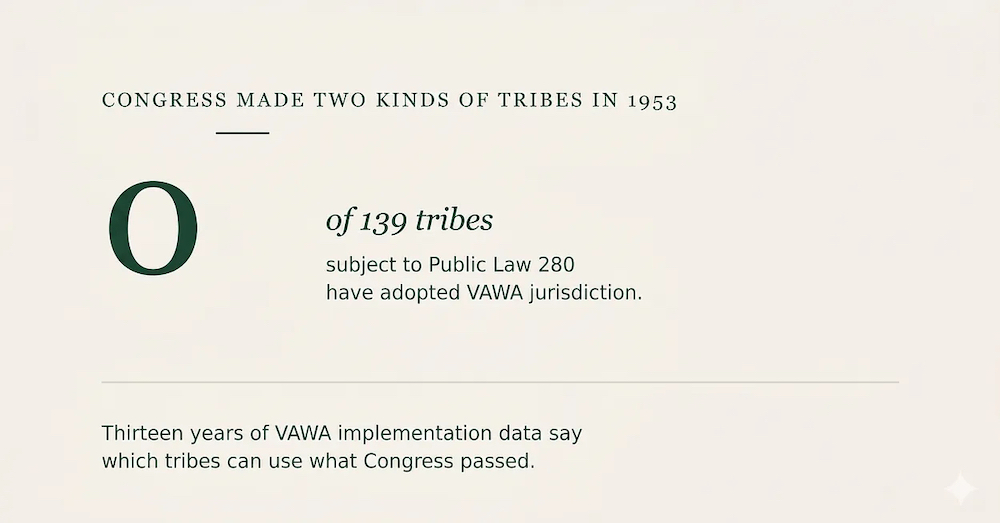
This post tells the story from one tribal court’s books. It also explains who has adopted and who has not. Of the 347 federally recognized tribes in the lower 48, only one group has adopted VAWA jurisdiction in any meaningful numbers, and one group has not adopted at all. Of the 31 tribes that have adopted VAWA special jurisdiction, none are tribes subject to Public Law 280 (a 1953 statute that transferred criminal jurisdiction over many tribes to state governments). The probability of observing this split by chance is roughly three in one hundred million.8
What follows is what the practitioners told me, what the data confirm, and what the next reauthorization could fix.
What “adopting” actually means
Some background is useful here. Since the Supreme Court’s 1978 ruling in Oliphant v. Suquamish Tribe, tribes have no criminal jurisdiction over non-Indians. The default rule is that a non-Native person who commits a crime on tribal land, including assault, domestic violence, or worse, against a Native victim, can be prosecuted only by the federal government or, on Public Law 280 land, by the state. Federal prosecutors decline more than half of violent cases referred from Indian Country.9 The state alternative is no better: in the most thorough study of Public Law 280 jurisdictions to date, residents on PL 280 reservations rated state and county law enforcement as less available, slower in response time, and less responsive to community priorities than residents on non-PL 280 reservations rated their federal and tribal officers.10 Tribes have watched serious crimes against their own people go unprosecuted for nearly half a century.
Special Tribal Criminal Jurisdiction (STCJ) is a narrow corrective. VAWA 2013 created an exception for non-Native defendants in domestic violence cases on tribal land. VAWA 2022 expanded the exception to additional covered crimes, including child violence, sex trafficking, sexual violence, stalking, and obstruction of justice. It does not cover assault outside a domestic relationship. It does not cover property crimes. It does not cover civil matters. It is a narrow exception to the Oliphant default, and it is the only criminal authority over non-Indians that most tribes can exercise.
When a tribe adopts Special Domestic Violence Criminal Jurisdiction, it does not apply for federal approval. There is no application. There is no federal sign-off. There is no registry. The tribe posts its codes publicly, meets the federal procedural minimums, and then declares that it will exercise the jurisdiction. Prosecution follows. Whether the tribe has met the federal procedural requirements only gets tested when a defendant challenges the tribe’s authority on appeal. Compliance is what Jennifer Cross at the Bureau of Indian Affairs calls “an affirmative defense.”11 The tribe has to prove it after the fact, not before. Federal oversight stops at design. Implementation belongs to the tribe.
Millard put it directly: the legal declaration was simple, once they figured out it could be done as a tribal council resolution. “We were all just overthinking it,” she said. The hard part comes before and after: building the court system that can sustain prosecutions, and absorbing the costs the federal government does not cover.
The lack of federal oversight is also why nobody has a definitive count. The two non-federal sources that track adoption, the Tribal Law and Policy Institute and Sidorsky and Schiller, agree on 31 Special Domestic Violence Criminal Jurisdiction (SDVCJ) adopters and 17 TLOA implementers. Both depend on tribes voluntarily reporting, so the actual current figures are probably higher. No federal entity publishes either count.
Before a tribe can exercise the jurisdiction, the following must be in place:
An established tribal court system.
Bar-admitted, law-trained judges. What that means in practice, Millard told me, is that “you can’t have the local businessman be a judge.” The federal procedural minimums require judges who have passed a state bar.
Defense counsel willing to practice in remote tribal courts. Cross said this is one of the most common practical barriers. Non-Native defendants have a federal right to counsel. The tribe must find that counsel.
Codes drafted at attorney hourly rates to incorporate the new VAWA 2022 covered crimes, including codes for child violence, sex trafficking, and obstruction of justice.
Public access to those codes.
A jury pool that meets the federal cross-section requirement.
Each of these is achievable. Each costs money. The federal grant does not cover these costs, so the tribe pays them from general revenue, which for many tribes is small.
Seventeen tribes have built the institutional stack for TLOA-enhanced sentencing. Thirty-one have built the additional layer required for STCJ. Most tribes have built neither.
So what convinces a small tribe to take this on? Millard’s answer was direct: if the tribe does not prosecute, the question is whether anyone else will. The state may decline. The federal prosecutor may decline. A domestic violence victim whose abuser is non-Native could fall through the jurisdictional gap entirely. For some tribes, adopting STCJ is the only way to ensure that someone has the authority to act.
The hundred beds problem
VAWA 2022 raised the maximum tribal sentence to three years per offense, with sentences for multiple offenses tried together capped at nine years total. Tribal jails are short-term facilities, designed for sentences of months, not years. For anything longer, tribes rely on the federal Bureau of Prisons (BOP).
The BOP allocates a total of 100 beds for all implementing tribes nationwide.12
The program is at full capacity, and the waiting list to place someone in one of those beds runs for about eighteen months.
The largest implementing tribes are Cherokee, Muscogee, and Chickasaw Nations, whose tribal court caseloads expanded sharply after the Supreme Court’s 2020 McGirt decision returned criminal jurisdiction over much of eastern Oklahoma to tribal authority. They fill those beds quickly.13 A small tribe that wins a conviction on a serious offense and sentences the defendant to three years has two options: hold him in the tribal jail at $50 per day for as long as it takes for a federal bed to open up, or release him.
Eighteen months at $50 per day is roughly $27,000 per defendant. That is the cost a tribe absorbs if it holds someone for the full federal wait. The math is what makes some tribes choose release over conviction.
The 100-bed cap shapes adoption in a less visible way as well. According to the most recent public tracking by the Tribal Law and Policy Institute, only three of the seventeen tribes that have implemented TLOA enhanced sentencing had actually placed a defendant in the Bureau of Prisons.14 The reasons are not separable from the data. Some of these tribes may not have had cases that warranted a multi-year sentence. Others probably have those cases but cannot face the wait, and have decided that long sentences are impractical to impose. Either way, the BOP is not functioning as the back end that the federal design assumes. Most tribes that have built the TLOA infrastructure are not using the federal prison system to serve sentences.
Quapaw has asked the federal government to raise the cap from 100 to 300. That requires an act of Congress. Quapaw’s broader position, raised in federal tribal consultations, is that the BOP should have administrative authority to scale beds based on caseload. A federal court does not ask Congress for permission each time the docket grows. A U.S. Attorney’s office does not stop indicting because the federal prison system is full.15
The BOP bottleneck did not exist by accident. When TLOA was being negotiated in 2010, the federal government had to decide how to handle longer tribal sentences. Federal facilities were the obvious answer. Setting the bed cap at one hundred was the cost-control mechanism. It became, in practice, the adoption-control mechanism. A tribe that wants to use TLOA’s sentencing authority for serious violent offenders is on notice that the federal infrastructure to back that authority is rationed.
Charles Addington at the BIA put the federal capacity gap in stark numbers. About 200 tribal law enforcement programs serve 575 tribes. Crime scene response times in some places run four to six hours. Violent crime on reservations averages roughly twice the national rate; on the worst-affected reservations, it runs thirty to forty times higher.16 Against that background, Congress designed a fix that requires tribes to provide the prosecutorial, judicial, and detention infrastructure that the federal government, the original guarantor of public safety on those reservations, has not provided.
The medical cost trap
The heart attack story I opened with is one example of an expense category Congress did not anticipate. Non-Native defendants are not eligible for the Indian Health Service. Any medical event in tribal custody becomes a direct tribal expense: a heart attack, a dental emergency, a mental health crisis, a broken arm, a defendant in withdrawal. A single emergency room visit comes back as a five-figure bill. A negotiator can bring it down. The negotiator might not be available next time.
Special Tribal Criminal Jurisdiction is delegated federal authority, not inherent tribal sovereignty. Before VAWA 2013, tribes had zero criminal authority over non-Indians; the federal government held that authority and was supposed to exercise it. By delegating prosecutions to tribes without funding them, Congress is asking tribes to pay for work the federal government would otherwise pay for itself.
There is a mechanical fix here, not an ideological one. When Congress authorizes a tribe to prosecute a non-Native defendant, the federal government should pay for that defendant’s medical care while in tribal custody. When a state prosecutes a defendant, the state pays for prosecution, incarceration, and medical care while the defendant is in custody. When the federal government prosecutes a defendant, the federal government pays for all three. When a tribe prosecutes a non-Native defendant under federal authority that Congress restored in 2013, the tribe pays for prosecution, pays the medical costs the IHS is not authorized to cover, and competes with thirty other tribes for partial reimbursement from a $3.2 million pool. The federal government authorized the jurisdiction. The federal government did not fund it.
The funding cliff
A $520,000 STCJ grant from the BIA, spread over three years, covers part of one prosecutor, part of Millard’s salary, and part of one additional staff position at Quapaw. The $3.2 million VAWA reimbursement pool is divided among 31 implementing tribes. Quapaw’s share is about $100,000 per year. One year of operations at Quapaw costs more than that, and Quapaw is one of the smaller adopters.
When the three-year grant expires, the tribe pays for everything from general revenue.
Tribal Justice Support funding is, as Cross described it, “one-time discretionary, requested annually.” It can be spent on judges, code development, prosecutors, defense counsel, clerks, and equipment. It cannot be spent on law enforcement officers, utilities, rent, or attorney fees. “You have to ask for it every single year.”
Congress funds federal criminal prosecution as a permanent function of the federal government. U.S. Attorney offices receive base operating appropriations. Federal courts receive indefinite appropriations. The Bureau of Prisons receives capacity that grows with conviction volume.
Tribal prosecution under federal authority is funded as a competitive grant.
Why the map looks the way it does
Cross made a point that reframed how I read my own data. The realistic pool of adoptees for STCJ is much smaller than the 347 federally recognized tribes in the lower 48.
Public Law 280, enacted in 1953, transferred criminal jurisdiction over Indian Country from the federal government to certain state governments without tribal consent. Tribes within Public Law 280 jurisdictions can technically exercise concurrent criminal jurisdiction, but most do not, because building the infrastructure to do so is, in Cross’s words, “very, very cost-prohibitive.” Among non-Public Law 280 tribes, the tribe holds primary criminal jurisdiction over its own members; among Public Law 280 tribes, the state holds it instead. Either way, neither tribe nor state has had jurisdiction over non-Indians since 1978, except where Special Tribal Criminal Jurisdiction applies.
If Cross is right about the cost barrier, the prediction is straightforward: tribes subject to Public Law 280 will adopt VAWA special jurisdiction at lower rates than tribes that already run their own criminal courts. I checked this prediction using the Sidorsky-Schiller list. The data does not show a lower rate. It shows zero.
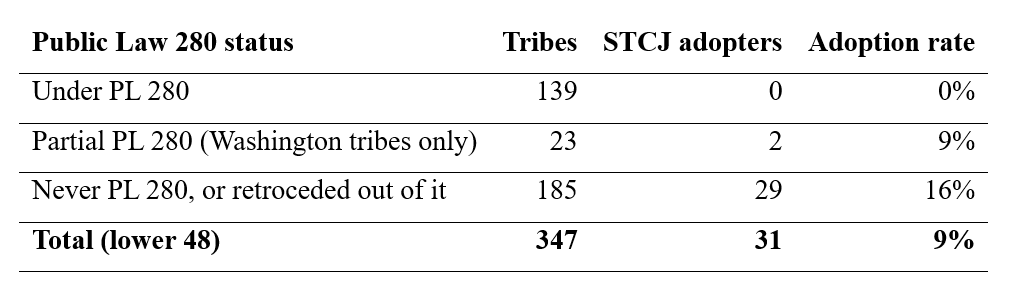
Source: Author’s analysis of 347 lower-48 federally recognized tribes, classified using the Sidorsky-Schiller (2024) list of STCJ adopters. Public Law 280 status coded as of the 2014–2022 SDVCJ-eligibility window.
Of the 31 tribes that have adopted VAWA special jurisdiction since 2013, none are tribes subject to Public Law 280. Out of 139 PL 280 tribes during the 2014 to 2022 opt-in period, none adopted. Of the 185 tribes never subject to Public Law 280 (or that successfully reclaimed their criminal jurisdiction from the state, in a process called retrocession that requires state agreement), 29 adopted. The remaining two adopters are tribes operating under Washington’s partial Public Law 280 regime, which left general criminal jurisdiction with the tribe. The adoption rate among tribes never subject to Public Law 280 is 16 percent. The adoption rate among tribes subject to Public Law 280 is zero.
The reason this gap matters is concrete, not theoretical. A tribe not subject to Public Law 280 already runs its own criminal court: its own judges, its own prosecutor, its own jail, its own codes. When VAWA arrives, the question facing that tribe is whether to extend its existing court to a narrow new category of defendant. The marginal cost is real but manageable. A tribe subject to Public Law 280 does not have its own criminal court. The state has handled criminal matters there since 1953. For that tribe, VAWA does not offer an extension; it offers the right to build an entire criminal justice system from scratch in order to prosecute one narrow class of cases. The federal design treats both decisions as the same opt-in.
Two-bar chart of STCJ adoption rate by Public Law 280 status.
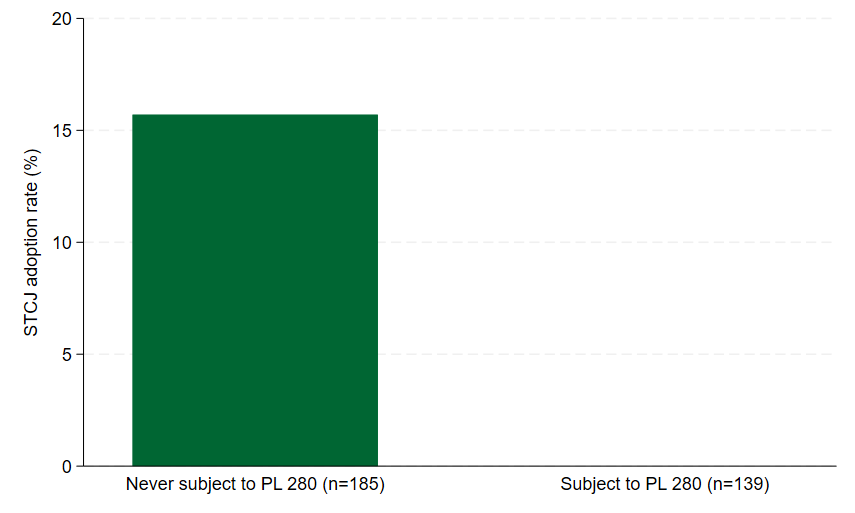
STCJ adoption rate by Public Law 280 status, lower 48 federally recognized tribes, 2014–2022 eligibility window. Tribes under Washington’s partial PL 280 regime (n=23, 9% adoption) are shown in the table above and excluded from this chart for clarity. Author’s analysis.
The pattern is even more telling once you trace the VAWA adopters’ histories. Six of the 29 non-PL 280 adopters were once subject to Public Law 280, sometimes by federal mandate in 1953 and sometimes by their own consent in the years after. All six successfully retroceded out of state jurisdiction before VAWA existed. The Confederated Tribes of the Umatilla retroceded their criminal jurisdiction in 1981, built a criminal court system, and adopted VAWA jurisdiction 33 years later as a 2014 pilot tribe. Tulalip retroceded in 2000 and adopted in 2014. The Chehalis Reservation, Quinault, Suquamish, and Swinomish all retroceded between 1969 and 1989 and adopted between 2018 and 2021.
The sequence is not a coincidence. The tribes that pursued retrocession are also the tribes that built their own criminal justice systems. They were also, decades later, the tribes positioned to use VAWA’s narrow exception when it arrived. The selection works the other way as well: one former PL 280 tribe, Quileute, retroceded alongside Chehalis and Swinomish in 1989 and has an active court today, but has not adopted VAWA jurisdiction. Removing the federal-state barrier opens the possibility of adoption. It does not by itself produce it.
When the right denominator is used, the picture changes. Among the 185 lower-48 tribes that are not subject to Public Law 280, 16 percent have adopted VAWA jurisdiction. That is almost three times the rate you get if you compare against all 347 federally recognized tribes, and infinitely higher than the zero rate among the 139 tribes subject to Public Law 280. The headline “tribes are not adopting” is wrong. The structural reading is that tribes that already run their own criminal courts adopt at a meaningful rate; tribes whose criminal jurisdiction was transferred to states do not adopt at all. What this means in practice: every Public Law 280 tribe is a tribe whose members watched VAWA pass in 2013, watched 31 other tribes use it, and could not.
Public Law 280 is the structural barrier to adopting VAWA jurisdiction. Cost, defense counsel access, BOP capacity, and federal funding design are operational barriers that affect every implementing tribe. Tribes not subject to Public Law 280 face only the operational barriers. Tribes subject to Public Law 280 face the operational barriers plus a structural one: they have no criminal court system to extend in the first place. The current federal design treats both groups of tribes as facing the same choice. They are not.
There is one tribe to watch. The Confederated Salish and Kootenai Tribes of the Flathead Reservation in Montana retroceded their Public Law 280 jurisdiction in two stages, completing the full exit in 2024–25. They were the only lower-48 tribe still subject to Public Law 280 throughout the entire VAWA 2013 era. They did not adopt during that window. If Cross is right that Public Law 280 is the binding barrier, the prediction is that CSKT will adopt now.
What the next reauthorization could fix
Among tribes not subject to Public Law 280, adoption is real. Among tribes subject to Public Law 280, adoption is zero. The federal government created this gap. Public Law 280, enacted in 1953, drew the dividing line between the two groups.17 Only Congress can erase that line directly. States can also choose to return jurisdiction to the federal government, but the decision belongs to them.
The Bureau of Prisons should have administrative authority to scale beds with caseload. The 100-bed cap was set as a cost-control measure in 2010. Sixteen years on, only three of the seventeen TLOA tribes have used a federal bed. Quapaw has asked for this change in federal consultations. Allowing the BOP to expand capacity as caseload grows would let the federal prison system actually function as the back-end for tribal enhanced sentencing.
Federal medical reimbursement should follow federal authority. When Congress authorizes a tribe to prosecute a non-Native defendant, the federal government should pay for that defendant’s medical care while in tribal custody. States pay for state defendants. Counties pay for county defendants. The federal government pays for federal defendants. Only tribes prosecuting under federal authority pay for the defendants Congress assigned them.
Tribal courts exercising federal jurisdiction should receive base operating funding. Federal courts, U.S. Attorney offices, and the BOP all receive permanent appropriations. Tribal courts exercising the same federal authority receive three-year competitive grants. The disparity is structural. It is a feature of how Congress has chosen to fund tribal jurisdiction, and it is a choice that can be unmade.
Last month, I argued in "Congress Keeps Giving Tribes Powers They Can’t Afford to Use" that Congress keeps authorizing without funding. This post is a picture from one tribal court’s books.
The tribes that have implemented STCJ are running successful courts. They have done so often without much federal help, and in some cases under conditions where federal prosecutors and federal facilities could not keep up with the caseload.
The tribes that have not adopted are not just smaller, or poorer, or more remote. They are concentrated among the 139 tribes still subject to Public Law 280, an arrangement Congress enacted in 1953 and never repealed.
The tools Congress passed in 2010, 2013, and 2022 sit on a shelf for most tribes because they cannot afford to use them. Tools that sit on a shelf are not tools. They are expressions of intent.
Congress created two kinds of tribes in 1953. The Quapaw Nation court is doing the work that Congress’s design made possible. One hundred and thirty-nine tribes cannot afford that option.
Thomas Stratmann is a University Professor of Economics and Law at George Mason University and a senior research fellow at the Mercatus Center. He publishes Rules & Results on Substack and created the Reservation Economic Freedom Index.
1 Conversation with Corissa Millard, Quapaw Nation court administrator, April 14, 2026.
2 Same source.
3 Same source.
4 The widely cited count of 8 TLOA enhanced-sentencing tribes comes from a National Congress of American Indians webpage that has not been actively maintained for years. The Tribal Law and Policy Institute has more recently tracked TLOA implementation, and its most recent published chart (December 2022) lists 17 implementing tribes. As Chia Halpern Beetso of TLPI cautions, even this count likely understates current implementation, because the chart is updated only when tribes voluntarily report. The actual current figure is presumably higher than 17. See TLPI, VAWA, and TLOA Implementation Chart (December 2022).
5 The 31 figure refers to tribes that have implemented Special Domestic Violence Criminal Jurisdiction since VAWA 2013, drawn from Sidorsky and Schiller (2024) and the TLPI December 2022 chart. VAWA 2022 expanded this jurisdiction to additional covered crimes (child violence, sex trafficking, sexual violence, stalking, obstruction of justice) and renamed it Special Tribal Criminal Jurisdiction (STCJ). I use STCJ throughout to refer to the current 2022 regime. Most of the 31 SDVCJ implementers continue to operate under the expanded STCJ authority. The structural finding in this post is robust to count uncertainty: even if the true number of adopters is closer to 35, the share of PL 280 tribes among adopters remains zero.
6 Author’s analysis of BIA HEARTH lease records. See Stratmann, “Congress Keeps Giving Tribes Powers They Can’t Afford to Use,” Rules & Results (March 2026).
7 This post focuses on the lower 48. VAWA 2013 excluded Alaska entirely from STCJ. VAWA 2022 created a separate Alaska pilot, but implementation barriers in Alaska, including geography and the unique jurisdictional status of Alaska Native villages, are different enough to warrant separate treatment.
8 Author’s analysis of 347 lower-48 federally recognized tribes, classified using the Sidorsky-Schiller (2024) list of 31 STCJ adopters and Public Law 280 status during the 2014–2022 SDVCJ-eligibility window. Fisher’s exact test (one-sided): p = 3.14 × 10⁻⁸. Five sensitivity specifications all reject the null at p < 10⁻⁶. Master classification source for retrocessions: Goldberg and Champagne, Final Report: Law Enforcement and Criminal Justice Under Public Law 280 (UCLA / U.S. DOJ NIJ, 2007). Full classification dataset available on request.
9 FBI Legal Digest, “Indian Country and the Tribal Law and Order Act of 2010,” citing Department of Justice data showing 52 percent of violent cases and 40 percent of nonviolent cases referred from Indian Country between 2005 and 2009 were declined for prosecution.
10 Goldberg, Carole, and Duane Champagne, Final Report: Law Enforcement and Criminal Justice Under Public Law 280 (UCLA / U.S. DOJ NIJ, 2007). Based on more than 350 interviews and surveys at sixteen reservations. The full dataset is publicly available through ICPSR (study 34557).
11 Author’s conversation with Jennifer Cross, Acting Associate Director, BIA Tribal Justice Support, April 16, 2026.
12 25 U.S.C. § 1302a: “The Bureau of Prisons shall confine not more than 100 tribal offenders at any time.” The 100-bed cap was set by the original Tribal Law and Order Act pilot program in 2010 and made permanent by VAWA 2022. See also Bureau of Prisons Tribal Offenders Program; U.S. Department of Justice, Office of Tribal Justice, FY2024 legislative proposal to expand the program. The DOJ confirms the program “is at full capacity with a waiting list.”
13 Following the Supreme Court’s 2020 McGirt v. Oklahoma decision, the Five Tribes (Cherokee, Chickasaw, Choctaw, Muscogee, and Seminole) collectively filed nearly 13,000 criminal cases in their tribal courts as of an April 2022 Supreme Court filing. Muscogee Nation reported a thirtyfold increase in criminal filings; Cherokee Nation earmarked nearly $30 million annually for criminal justice expansion. The Quapaw Nation reservation was also confirmed as never disestablished under the same line of rulings. The post-McGirt caseload increase plausibly drives the higher BOP placement volume from these tribes relative to other STCJ implementers.
14 TLPI, VAWA, and TLOA Implementation Chart (December 2022), column tracking tribes that have utilized the Bureau of Prisons. Three tribes, Confederated Tribes of the Umatilla, Tulalip Tribes, and Eastern Band of Cherokee Indians, are listed as having placed defendants in BOP. The figure is current as of December 2022 and may understate utilization since.
15 Demand for the federal beds will only grow. VAWA 2022 created an Alaska pilot program; as Alaska tribes begin implementing, they will compete for the same 100 beds with lower-48 implementing tribes. The cap is binding now and will become more binding.
16 Charles Addington, presentation at Tribal Self-Governance Conference, April 8, 2026.
17 Public Law 280 has effects that extend beyond criminal jurisdiction. Anderson and Parker, “Sovereignty, Credible Commitments, and Economic Prosperity on American Indian Reservations,” Journal of Law and Economics 51(4), 2008, find that PL 280 jurisdictions show higher per capita income growth, plausibly because state jurisdiction reduces uncertainty for outside capital. The argument here is narrowly about criminal jurisdiction over non-Indians under VAWA, where PL 280’s effect is foreclosing rather than facilitating.