


- Details
- By Native StoryLab
- Sponsored Storytelling
Sponsored Storytelling. For more than a decade, Indigenous researchers and advocates have built frameworks to govern Native data.
That work, long confined to academic circles, is now colliding with a broader shift in the economy. Artificial intelligence, precision health, federal data centralization efforts and global research demand are all accelerating the value of data — including data tied to Indigenous peoples, lands and cultures.
“Indigenous data sovereignty isn’t new,” said Joseph Yracheta, executive director of the Native BioData Consortium, an Indigenous-led nonprofit research center and data repository based on the Cheyenne River Sioux Reservation. “What’s new is the scale of demand for data — and the risk that decisions get made without tribes at the table.”

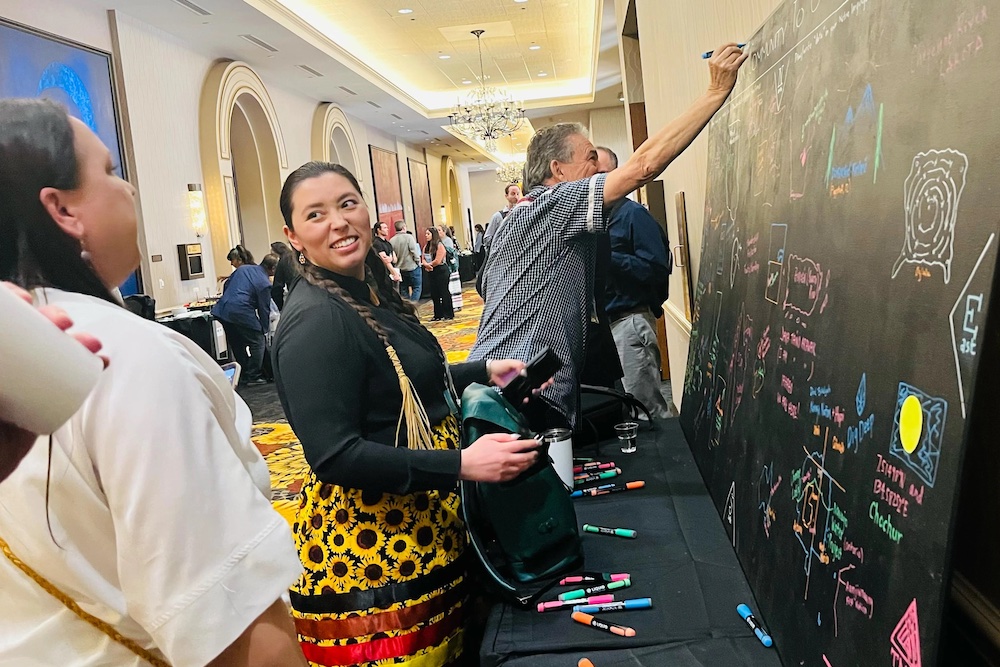
How tribes respond to those pressures will be central to the U.S. Indigenous Data Sovereignty & Governance Summit, April 14–17, 2026, at Casino Del Sol on the Pascua Yaqui Tribe’s lands in Tucson, Ariz., with a virtual option.
Organizers say the event is less about introducing a concept than addressing decisions already underway.
From principles to implementation
The Indigenous data sovereignty movement has evolved significantly in recent years.
Early efforts focused on defining principles — most notably the CARE Principles for Indigenous Data Governance, which emphasize collective benefit, authority to control, responsibility and ethics. Those principles emerged in response to “open data” frameworks that prioritized access and reuse, often without regard for Indigenous rights.
Now, the work is moving into implementation.
That includes developing data standards, legal frameworks and governance models — and engaging institutions that shape how data is used.
One example is ongoing work tied to the Institute of Electrical and Electronics Engineers (IEEE), where Indigenous data leaders have contributed to emerging standards around data provenance and governance. The goal is to embed Indigenous authority and consent into the technical systems that underpin data use — not layer it on afterward.
“This is about making sure Indigenous governance is built into the infrastructure itself,” Yracheta said.
The network behind the summit — including Native BioData and partners in the U.S. Indigenous Data Sovereignty Network — has also spent years working with major philanthropic organizations, including the MacArthur Foundation and others, to reshape how funding supports Indigenous data efforts.
That includes pushing for long-term capacity — secure data systems, workforce development and governance — over short-term projects.
A growing risk — and a familiar pattern
The urgency behind the summit reflects a convergence of risks that organizers say mirror earlier extractive relationships in natural resources and research.
In biomedical research, Indigenous populations are often seen as high-value datasets because of their distinct genetic profiles — offering what one researcher described as “the biggest bang for the buck” in discovery. Yet those communities frequently see little return from resulting treatments or technologies.
At the same time, legal and policy gaps continue to expose tribal data.
Research agreements that appear protective can be undermined by mechanisms like public records requests. Data shared in one context can be reused in another. Emerging federal efforts to centralize data raise new questions about ownership and control.
Critics increasingly describe these dynamics as a form of “surveillance colonialism” — where data is extracted under the banner of openness or innovation, without fully honoring Indigenous consent or governance.
“Open data isn’t neutral,” said Sierra H., a conservation social scientist, in a recent presentation. “If it doesn’t center free, prior and informed consent and government-to-government relationships, it becomes another mechanism of extraction.”
Similar concerns are now playing out globally. A recent analysis of Canada’s $200 million precision health initiative found that large-scale genomic data collection was being advanced ahead of meaningful Indigenous governance — raising the risk of repeating past patterns of dispossession.
Why tribal leadership matters now
Much of the work in Indigenous data governance remains driven by researchers and nonprofit organizations.
“Academics can raise the issue, but we don’t have the authority to change tribal regulations or influence federal policy,” Yracheta said. “Tribal leaders do.”
Countries such as New Zealand and Australia have already moved further in this direction, embedding Indigenous authority into national data systems and securing funding to support it. In the United States, organizers say, similar progress will depend on greater engagement from tribal governments.
That is a central goal of the summit.
The four-day hybrid event will include a Native-only master class, technical sessions, legal discussions and student programming, alongside broader panels open to all participants. Sessions will cover topics ranging from artificial intelligence and data governance to legal frameworks, public health, and the energy and infrastructure demands of data systems.
Organizers are also intentionally structuring parts of the event to center Indigenous voices, including sessions where only Native presenters share their work.
A decision point for tribal leaders
The 2024 summit in Tucson drew more than 450 in-person attendees and 220 online participants, far exceeding expectations and signaling growing demand for engagement on the issue.
For philanthropic funders, that means understanding how to support Indigenous-led data systems. For policymakers and federal agencies, it means recognizing tribal authority in data governance. And for tribal leaders, it means deciding how — and whether — to engage in a rapidly evolving data economy.
“This is about making sure tribes are not reacting after the fact,” Yracheta said. “It’s about being in position before decisions get made.”
Registration for the summit is open, with options for both in-person and virtual participation.
For organizers, the stakes are clear: Decisions on data are already being made. The question is whether tribes are setting the terms — or reacting to them.
DISCLOSURE: This article is sponsored content created by Native Story Lab for Native BioData. It was created as part of a paid partnership and was not produced by the Tribal Business News editorial team.